Saturday, February 27, 2016

Panama Canal

The Panamá Canal is a 48-mile (77 km) ship canal in Panama that connects the Atlantic Ocean (via the Caribbean Sea) to the Pacific Ocean. The canal cuts across the Isthmus of Panama and is a key conduit for international maritime trade. There are locks at each end to lift ships up to Gatun Lake, an artificial lake created to reduce the amount of excavation work required for the canal, 26 metres (85 ft) above sea level. The current locks are 33.5 metres (110 ft) wide. 
A third, wider lane of locks is currently under construction and is due to open during 2016.
The layout of the canal as seen by a ship passing from the Atlantic to the Pacific is as follows:

From the formal marking line of the Atlantic Entrance (A), one enters Limón Bay (1), a large natural harbour. The entrance runs 8.7 km (5.4 mi). It provides a deepwater port (Cristóbal), with facilities like multimodal cargo exchange (to and from train) and the Colón Free Trade Zone (a free port).

A 2.0 mi (3.2 km) channel forms the approach to the locks from the Atlantic side.

The Gatun locks (2), a three-stage flight of locks 1.9 km (1.2 mi) long, lifts ships to the Gatun Lake level, some 26.5 m (87 ft) above sea level.
Gatun Lake (3), an artificial lake formed by the building of the Gatun Dam, carries vessels 24.2 km (15 mi) across the isthmus. It is the summit canal stretch, fed by the Gatun river and emptied by basic lock operations.
From the lake, the Chagres River (4), a natural waterway enhanced by the damming of Gatun Lake, runs about 8.5 km (5.3 mi). Here the upper Chagres river feeds the high level canal stretch.
The Culebra Cut slices 12.6 km (7.8 mi) through the mountain ridge, crosses the continental divide and passes under the Centennial Bridge for the Pan-American Highway via Panama City (5).
The single-stage Pedro Miguel lock (6), which is 1.4 km (0.87 mi) long, is the first part of the descent with a lift of 9.5 m (31 ft).
The artificial Miraflores Lake, 1.7 km (1.1 mi) long, and 16.5 m (54 ft) above sea level.
The two-stage Miraflores locks (7), is 1.7 km (1.1 mi) long, with a total descent of 16.5 m (54 ft) at mid-tide.
From the Miraflores locks one reaches Balboa harbour, again with multimodal exchange provision (here the railway meets the shipping route again). Nearby is Panama City.
From this harbour an entrance/exit channel leads to the Pacific Ocean at the Gulf of Panama (B), 13.2 km (8.2 mi) from the Miraflores locks, passing under the Bridge of the Americas  for the Arraiján–Panama City (8).

The total length of the canal is 77.1 km (48 mi).

Friday, February 26, 2016

Day 5 - Puerto Limón, Costa Rica

  
This morning we arrived at Puerto Limon in Costa Rica.
After breakfast we went on a tour by bus, train and boat.
First we visited a Del Monde banana plantation - interesting to watch bananas from plants to packing.(see video above)
Banana bunches are wrapped in  blue 
plastic when hung on the plant to protect against contamination and insects.

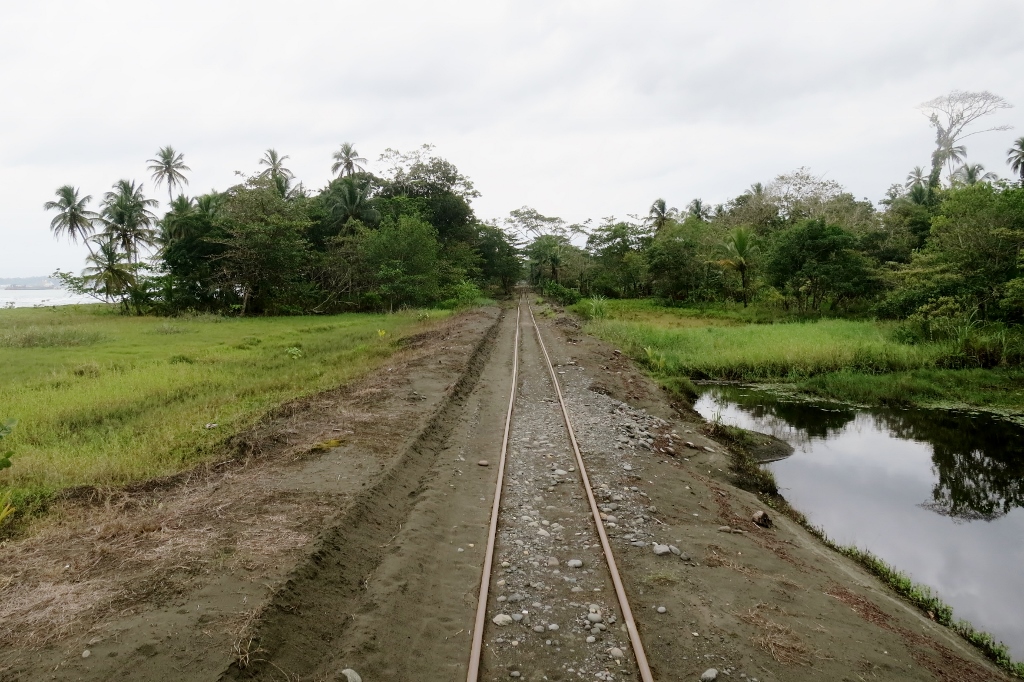
Then we drove with a narrow-gauge railway through the rainforest and along the coast - the track was originally built to carry cacao from the highlands to the port.(Also video above)
After the train we sailed on the canals in the rainforest. On the trip we saw sloths, birds (pictures below) and monkeys.
Back in Puerto Limon we took a walk up the city - including to find a net cafe.

Just outside the terminal next to Parque Vargas we found Cruccero Coffee Shop with a good wi-fi for Facetime/Skype.
We ate the evening in the main restaurant and got a glass of wine before bed time.


Puerto Limón, Costa Rica
Puerto Limón, commonly known as Limón  is the capital city and main hub of Limón province, as well as of the cantón (county) of Limón in Costa Rica. It is the second-largest city in Costa Rica after the capital, Part of the community traces its roots to Italian, Jamaican and Chinese laborers who worked on a late nineteenth-century railroad project that connected San José to Puerto Limón. Until 1948, the Costa Rican government did not recognize Afro-Caribbean people as citizens and restricted their movement outside Limón province. As a result of this "travel ban", this Afro-Caribbean population became firmly established in the region, which influenced the decision to not move even after it was legally permitted. The Afro-Caribbean community speaks Spanish and Limonese Creole, a creole of English.
 
Banana Plantation (Del Monte)
'Banana Train'
two toes sloth

Narrow Gauge Railway 
Tourist train
blue heron

To view the complete review click on 'Older Posts' below!

Thursday, February 25, 2016

Day 4 - At Sea

We sail towards southwest the 780 nautical miles ( 890 Miles /1.450 km) from Puerto Rico, and has just passed a timeline, so the clock is set back an hour.
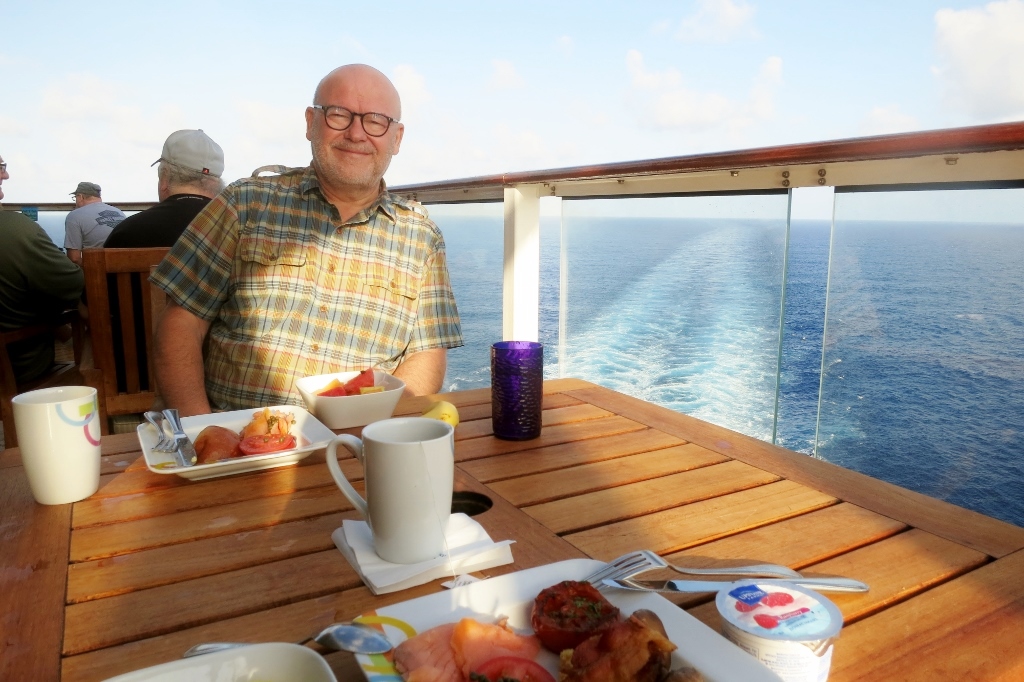
Up early and ate breakfast on the aft deck in Ocean View cafe  (pictured) in a fantastic weather.
After breakfast we went on the sundeck to enjoy the morning sun before it was too strong. A cup of coffee on the balcony and went for a walk around the ship, including to see if we could get inspiration for a 2017 cruise. After lunch we enjoyed the sun on our balcony until the sun was in and it was too hot. Found a place in the shade on the sun deck and read. Coffee in the afternoon sun on the balcony. It was a lovely warm evening so we chose to eat dinner in Ocean View cafe - outdoors on the aft deck. Lovely sushi followed by a steak.


Lunch at the afd deck Ocean View Cafe
Lounge area deck 5
Glas show

Wednesday, February 24, 2016

Day 3 - Cozumel, Mexico

We arrived to Cozumel in Mexico at  7 am in the morning.
We ate breakfast as we approached
San Miguel, the 'capital' at the island.
At 8 pm we went on a excursion around the island. First stop was a 'copy' of a Mayan village.
The Maya were displaced when the Spaniards came to Mexico because they were not immune to the diseases the Spaniards brought to Mexico.
After Mayan village we drove along the beach with large areas of mangroves. A strange nature. Last on the tour, we visited one of the few extant Mayan temples on the island.
Back at the harbor we found Cafe Punta del Cielo just outside the terminal that had internet and we connected to home via FaceTime, which is not possible on the ship due to the limited access to the network.


We ate lunch on the ship at. about 2 pm, and we enjoyed the sun, first on our balcony, but then  it gradually became too hot at the balcony  (the sun was directly) we went up on the sun deck and found a lounge chair in the shade.
Late in the afternoon we went to the gym. At 7 pm, it was time for dinner  - fresh tuna as appetizer, tenderloin for the main course and a pecan pie for dessert - a really tasty dinner.
After dinner we walked around the ship - heard the music, so to shops and drank a glass of wine.

Celebrity Equinox and brilliance of the Seas at the Port of Cozumel.


Cozumel
The island is located in the Caribbean Sea along the eastern side of the Yucatan Peninsula about 82 km (51 mi) south of Cancún and 19 km (12 mi) from the mainland. The island is about 48 km (30 mi) long and 16 km (9.9 mi) wide. With a total area of 477.961 km2 (184.542 sq mi), it is Mexico's largest Caribbean island, and Mexico's third-largest island, following Tiburón Island and Isla Ángel de la Guarda.
The majority of the island's population lives in the town of San Miguel which is on the island's western shore. 

Tuesday, February 23, 2016

Day 2 - At the Sea ; North of Cuba

Now we are sailing the 535 nautical mile (615 Miles/990 km) towards Cozumel in Mexico. 
We sailed most of the day along the north coast of Cuba.
After breakfast, we sat on our balcony and read. Before lunch we went in fittness.
Lunch in OceanView cafe where you as a Dane can sit outdoor and enjoy the good weather while many people prefer to stay indoors in the air conditioned cafe. After lunch we again were sitting on our balcony and got some sun and a cafe latte with a nice view over the very calm sea.


Today was the 'formal' night - changing to levening dress and tuxedo before dining in the restaurant. A nice dinner with salad, entrecote and fruit for dessert. After dinner, a glass of wine at the bar.
However, Formal night is now 'Evening Chic' - a modern luxury reboot, intended to be less dressy than formal - in my mind much less formal - I might be a bit 'old fashion cruising' who prefer the 'real' formal nights.
 
Main Restautant
Centrum of the ship
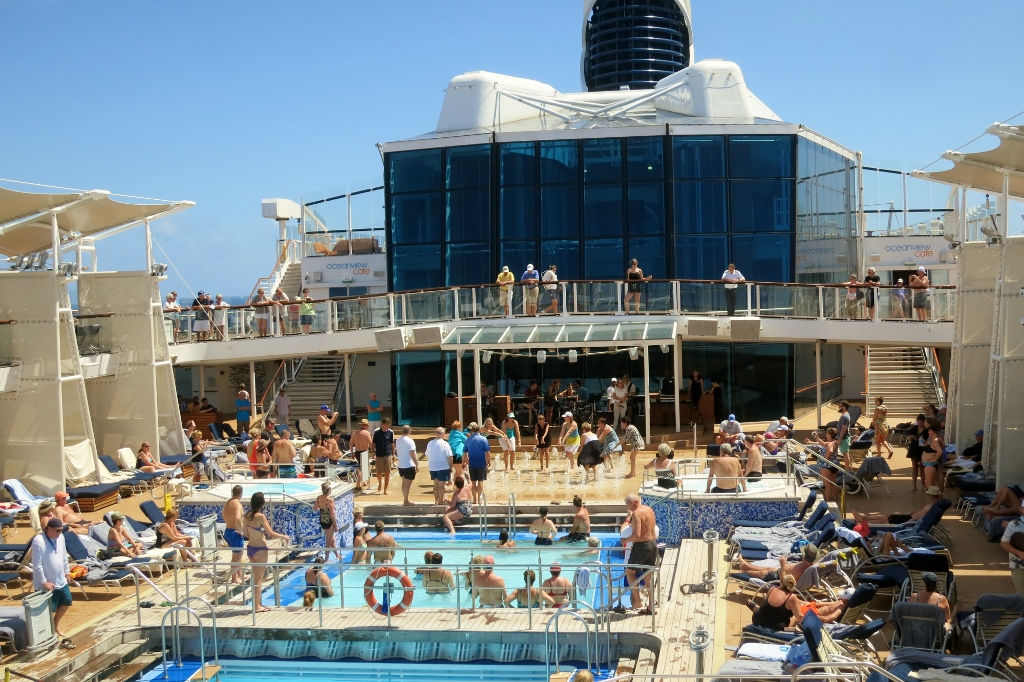
A nice day at the pool deck

Monday, February 22, 2016

Day 1 - Departure from Fort Lauderdale

The suitcases were packed and sometimes we got washed some clothes and eating breakfast.
At 10 we were ready to go ahead and we had ordered a taxi for the short ride to the cruise terminal.
It went quickly to deliver the suitcases and get checked in. We waited about 30 minutes  before we were ready for boarding. Boarding process and security went wery smooth.
Lunch in the Marketplace Cafe and at 1pm we got our cabin - 1162 at deck 10.

Category C1 - Concierge Class Stateroom - (more detailed review later).
We quickly got our suitcases, got un-packed and found room for all the clothes  before the muster drill.
We followed the sailaway from the sundeck before went down to our cabin and enjoyed the evening sun on our balcony while we passed Miami on the way south.
At 6PM we had dinner in the main diningroom and after dinner we listened to music in the center.
The network on the ship is extremely  slow and cannot be used for voice or Skype/Facetime.

Sunday, February 21, 2016

Pre stay in Fort Lauderdale


Before the cruise we did stay 5 days at Marriott BeachPlace Towers in Fort Lauderdale.
Fort Lauderdale lies on the Atlantic coast of Florida, 37 km north of Miami.
The city is named after a series of forts built by the United States during the civil wars. The forts were named after Major William Lauderdale.
It is a popular tourist destination, with an average temperature of 24 ° C, and 3,000 hours of sunshine annually. In Fort Lauderdale, there are 561 hotels and more than 4,000 restaurants.
The town is crisscrossed by canals. There are 100 marinas and more than 45,000 yachts registered in Fort Lauderdale. 

The bridges to Fort Lauderdale, all open so that the large yachts can enter the chanals.
46 cruise ships are sailing each week from Port Everglades, the port of Fort Lauderdale.
Click on the images from Fort Lauderdale to enlarge.


Saturday, February 20, 2016

Marriott's Beach Place Towers


The first 5 days of our holiday we stay at Marriott Beach Place Towers Fort Lauderdale.
It is part of the Marriott Vacation Club and we have traded a week at Mallorca for 5 days with an amazing trip across the Atlantic.


Below pictures from the resort and the view from our balcony .


click on images to view larger image.


Front of the Resort
Living room
Bedroom

Dining Room
View from the 'Villa'
Pool Area